A burst pipe in Anaheim, a slab leak under a San Jose floor, a garage flooded by a Mission Valley storm: the water does not care which California city you live in, and neither does the damage it leaves behind. That is why homeowners looking for water damage restoration california help start here: one call connects you with an independent local crew that handles extraction, structural drying, cleanup and repairs as one job, not four separate headaches.
What To Tell Us When You Call
Four details that help the local crew matched to your call bring the right equipment and get drying started sooner.
📞 (833) 555-0100Street address and ZIP code, so the crew closest to your home is the one that heads out to you.
A burst pipe, a slab leak, a water heater, an appliance, the roof, a sewer line, or storm water through a door.
If water is still flowing, stay on the line: we will talk you through shutting it off safely.
The rooms affected, whether floors, walls or ceilings are wet, and roughly how long it has been that way.
If you have standing water in a California home right now: shut off the water source if it is safe, keep clear of wet electrical outlets, take photos and video for insurance, and call (833) 555-0100 to be matched with a local crew that extracts the water and starts professional drying. Mold can begin within 24 to 48 hours, so the first day matters more than any other.
Water Damage Pros is a free connection service for California homeowners. We are not the crew that dries your home. We match your call with an independent local restoration contractor in your city, and that contractor does the work.
That distinction matters, and we state it plainly instead of hiding it. A statewide problem needs local hands: the crew that answers in San Diego knows Mission Valley river flooding, the crew in Lancaster knows Antelope Valley storm runoff and slab construction, and the crew in San Jose knows the slab leaks that hide under Silicon Valley floors for weeks. One number reaches all of them. You call, we match by city and ZIP code, and the local crew takes it from there: extraction, drying, cleanup and repairs, documented for your insurer as they go.
Every contractor in the network is independent. Verify the license and insurance of any contractor you hire, and get the scope of work in writing before work starts. That is good advice on any site, including this one.
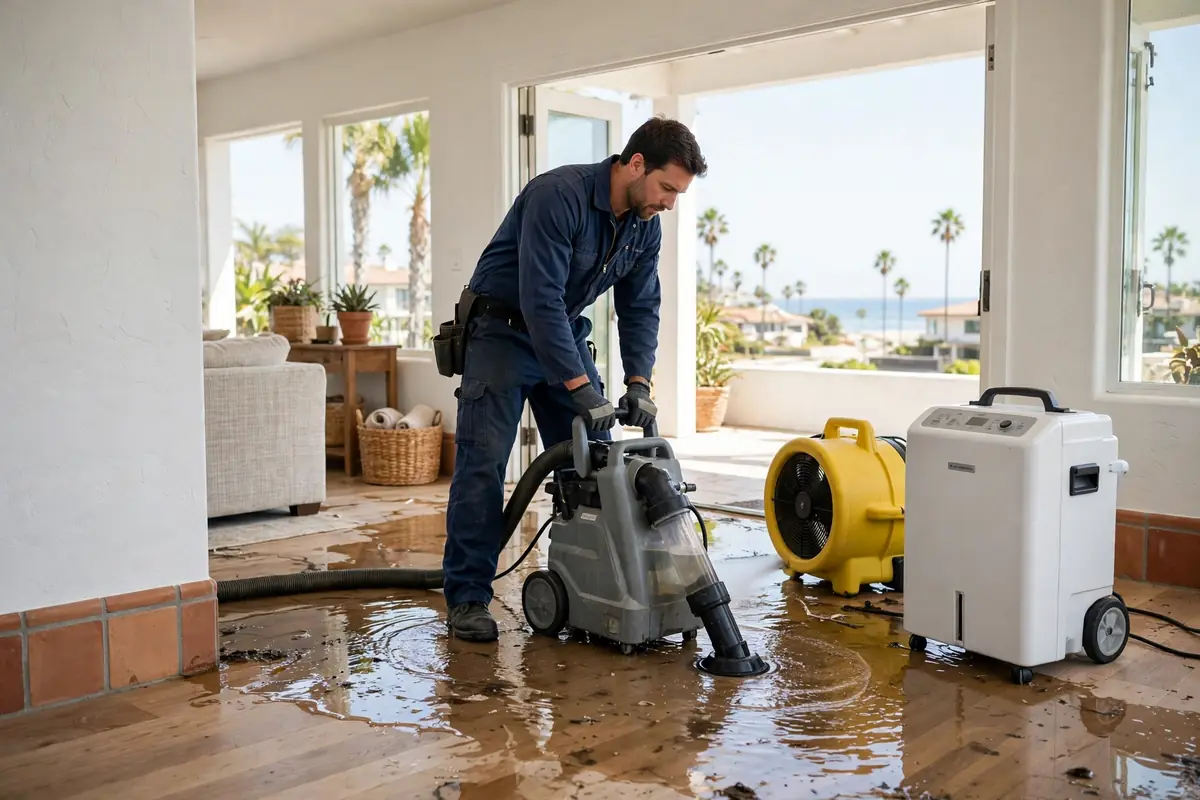
The first hour decides how much of your home can be saved. Work this list in order, and only where it is safe to do so.
If a pipe, hose or appliance is the cause, turn the water off at the main shutoff. For storm water, wait until the rain eases before working near the entry point.
If water is near outlets, appliances or the panel, switch the breaker off for those rooms. Never step into standing water that may be electrified.
Rooms, walls, floors, belongings, the source itself. Insurers pay on records, not memories, and photos taken before cleanup are the strongest record there is.
Documents, electronics, furniture legs out of the water. Do not throw damaged items away until your insurer has seen them or released them.
Every hour of standing water is more drywall, flooring and framing that cannot be saved. Call (833) 555-0100 and get a local crew moving.
Water damage is local. The rain that floods a Mission Valley condo is not the wind-driven storm that soaks a Santa Clarita tract home, and a Glendale hillside drains differently from a San Jose slab. So this site is built city by city: a full guide for each launch city, written for that city’s homes, weather and water. Start with yours.
San Diego River flooding in Mission Valley, coastal storm runoff, and slab leaks in the postwar suburbs from Clairemont to Rancho Bernardo. The largest water damage search demand in the state.
Hillside runoff, older plumbing in pre-war homes, and flash flooding along the Los Angeles River basin, from the Valley to Long Beach side of the county line.
Foothill runoff off the Verdugo Mountains, canyon drainage, and storm water that finds the lowest garage on the street.
Santa Ana River storm surges, aging tract-home plumbing, and water heaters that fail in attached garages across Orange County’s oldest suburbs.
Antelope Valley desert storms that drop a season of rain in an afternoon, swamp cooler leaks, and slab homes that hide slow supply-line failures.
Slab leaks under Silicon Valley floors, Guadalupe River winter flooding, and atmospheric river storms that test every roof in the Santa Clara Valley.
Santa Clara River washes, newer tract construction with PEX lines, and flash floods that run down from the hills after hard rain.
More city guides are on the way: Long Beach, Huntington Beach, Irvine, Sacramento and Fresno. If your city is not listed yet, call anyway: the network covers 2,084 California ZIP codes, and the call is matched by ZIP, not by whether a guide exists yet.
Six kinds of water damage cover almost every call in California. Each one has its own process, its own risks, and its own section in your city guide.
Truck-mounted and portable extractors pull standing water out of floors, carpets and padding before drying takes over. The first hours decide the size of the whole job.
A supply line lets go and a home takes on water by the gallon per minute. Source stopped, water out, structure dried, in that order.
A sewage backup is a biohazard, not a mopping job. Contaminated materials come out, hard surfaces are disinfected, and the crew works protected.
Atmospheric rivers, river flooding and post-fire debris flows bring silt and contamination with them. Pumping out, mucking out, disinfecting and drying, in that order.
Extraction removes the water you can see. Drying removes the moisture inside walls, floors and framing, verified by daily meter readings against a dry standard.
Mold can begin on wet materials within 24 to 48 hours. Fast extraction and verified drying are what keep a water job from becoming a mold job.
Four steps, in the same order on every job. A crew that skips one is leaving damage behind for you to find later.
The source is shut off or contained, power to wet rooms is made safe, and the damage is photographed before anything moves. Those photos become your insurance record.
Standing water comes out with truck-mounted and portable extractors. Wet materials are checked one by one: what can be dried in place, and what has to come out so the structure can dry.
Air movers and dehumidifiers run for days, not hours. Moisture readings are taken daily against a dry standard, and equipment comes out only when the numbers say the structure is dry.
Drywall, flooring, trim and paint go back in, in the order they came out. The final walkthrough checks the finished work against the original written scope.
California does not flood the way the Gulf Coast floods. Its water damage has its own local causes, and a crew that works here reads them the way a local reads weather.
Atmospheric rivers. Most of California’s serious rain arrives in a handful of winter storms that park over the coast and the Sierra foothills. Rivers like the San Diego, the Santa Ana, the Guadalupe and the Russian rise fast, and neighborhoods built along them, Mission Valley most famously, take water in hours.
Slab construction. Most California homes sit on a concrete slab with the water lines underneath it. A cracked line leaks upward through the floor for days before a warm spot, a warped board or a water bill gives it away. By the time a slab leak shows, the drying job is already real.
Fire, then rain. In the foothill communities, from Glendale and Pasadena to Santa Clarita, a burn scar on the hills above a neighborhood turns ordinary rain into debris flows. The first storm after a fire is a water event, and sandbags are only half an answer.
Aging pipes and desert storms. Galvanized lines in pre-war Los Angeles homes corrode from the inside. In the Antelope Valley and the Inland Empire, a summer storm can drop a season of rain in an afternoon on ground too hard to absorb it. Different causes, same rule: water out fast, structure dried by meter, nothing guessed.
Usually, when the water is sudden and accidental. The pattern across California homeowners policies looks like this.
A burst pipe, a split washing machine hose, a water heater that fails all at once. The cleanup, drying and repair of the damage that water caused is normally part of the claim, and the crew’s moisture records and photos become part of your documentation.
Slow leaks that ran for months, maintenance failures, and rising water from outside the home. Flood damage needs its own flood policy, which matters along every river corridor in the state. Many policies also cap mold work at a small sub-limit, so a water job left wet becomes a mold bill the policy barely touches.
This is the general pattern, not advice about your policy. Read your declarations page, and when in doubt, ask your insurer before the work, not after.
Different trades, different halves of the same emergency. A plumber fixes the pipe: the cracked line, the failed valve, the leaking water heater. A restoration crew handles everything the water did after it escaped: extraction, drying, cleanup and repairs. If water is still spraying, shut the main off and the order stops mattering. If the source is stopped and the house is wet, the restoration crew is the call that protects the home, and that crew will tell you plainly if a plumber is still needed for the source. One call to (833) 555-0100 starts with the crew, and the matching is done by your city and ZIP code.
Crews are local to your metro area, so in the launch cities most calls are answered with a crew the same day, often within hours. Rural addresses can take longer, and you will be told honestly on the call what the timing looks like for your ZIP code.
A full job has four parts: stop the water source, extract the standing water, dry the structure with air movers and dehumidifiers checked by moisture meters, and repair what the water damaged. Cleanup and disinfection run through every step.
Usually, when the water is sudden and accidental: a burst pipe, a failed water heater, a split washing machine hose. Slow leaks, maintenance problems and rising water from outside are usually not covered; flood damage needs its own flood policy. Read your declarations page, and document everything with photos.
Most California homes sit on a concrete slab, with water lines running underneath it. When one of those lines cracks, water rises through the floor for days or weeks before it shows. Shifting soil, corrosion and water pressure all play a part. A slab leak needs the water found, stopped, extracted and the structure dried, in that order.
If a pipe is still actively spraying, shut the water off at the main first. A plumber fixes the pipe; a restoration crew handles the water that already got out, the drying and the damage it left behind. One call here matches you with the crew for the water and the drying, and the crew can tell you if a plumber is needed for the source.
The network covers 2,084 ZIP codes across 41 California counties. City guides are rolling out now, starting with San Diego, Los Angeles, Glendale, Anaheim, Lancaster, San Jose and Santa Clarita, with Long Beach, Huntington Beach, Irvine, Sacramento and Fresno next. Coverage itself is matched by ZIP code, whether or not your city guide is published yet.
Coverage runs across 41 counties and 2,084 ZIP codes, in 864 communities statewide. The largest crew pools sit in these counties:
Matching is done by ZIP code, not by county line. If your ZIP is covered, a local crew is matched to your call, whether or not your city has a published guide yet.
Shut the water off at the main, keep clear of electrical hazards, and take photos before anything moves. Then make the one call that starts your water damage restoration california job with a local crew: extraction first, meter-checked drying behind it, and a written scope before repairs begin.